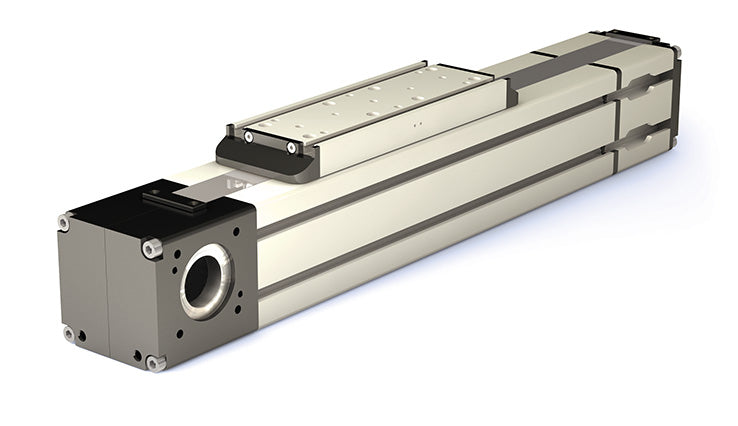
Linear Actuators

Linear Actuators

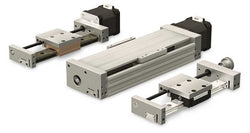
A linear actuator is a mechanical device that combines a linear guide, drive mechanism, carriage-guidance system, and power source to produce controlled straight-line motion for moving or positioning a load. The drive mechanism—such as a ball screw, lead screw, belt, or fluid-powered piston—creates linear force, while the guidance system supports the carriage, controls its path, and resists side, moment, and cantilevered loads. Linear actuators are commonly classified as electric, mechanical, pneumatic, or hydraulic; electric and mechanical designs are often selected for controlled positioning, repeatability, clean operation, and integration with automated machinery.

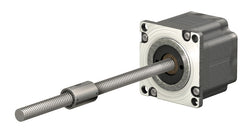
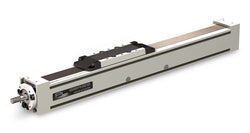
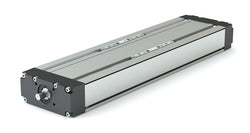
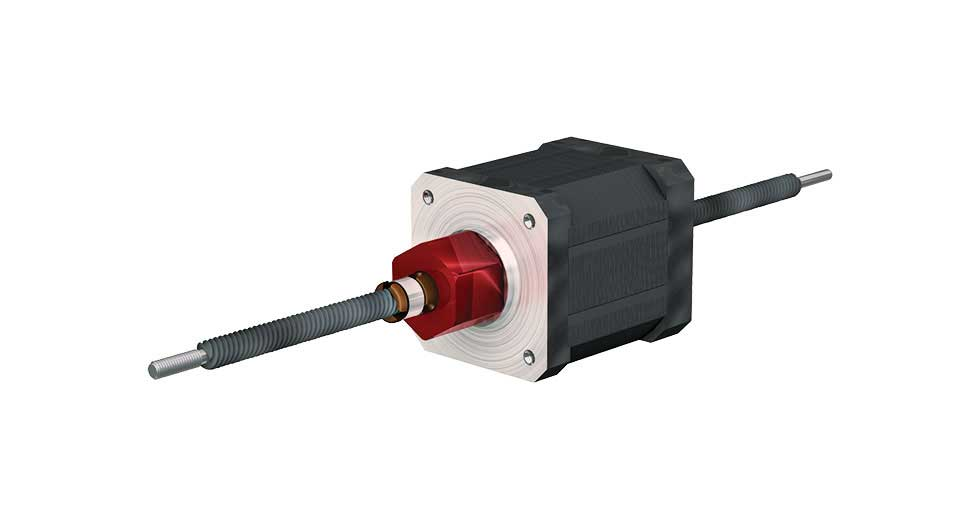
PBC Linear designs guided belt-driven and screw-driven actuators powered by NEMA motors or hand cranks. Belt-driven actuators support long strokes and high speeds with low maintenance. Ball screw actuators provide high efficiency, load capacity, and positioning accuracy, while lead screw actuators offer quieter, more cost-effective motion with anti-backlash options for improved repeatability. Screw-driven configurations include external-nut actuators, where the screw rotates and a restrained nut travels along it; captive actuators, where the nut rotates and pushes a non-rotating screw in and out; and non-captive actuators, where the rotating nut travels along a screw that passes through the motor. Available configurations include multiple screw diameters, lead sizes, NEMA frame sizes, motor lengths, and actuator lengths to match specific force, speed, and travel requirements. Carriage guidance is provided by either self-lubricating Gliding Surface Technology for low-maintenance operation in environments with dirt, heat, or vibration, or ball-bearing profile rails for greater moment capacity and cantilevered loads.

More About Linear Actuators

Ways to Order

Catalog Preview
Web Catalog Web Catalog Download PDF Download PDF Video Video Features Features

Browse Categories

188 products
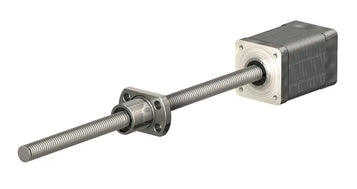
Miniature linear ball screw actuator with a screw diameter of 8mm, a lead of 2.5mm and a length of 250mm. Includes a NEMA 17 single stack motor and a flanged nut, it’s tailored for applications where space is at a premium but precision cannot be compromised. The assembly is delivered..
$293.98
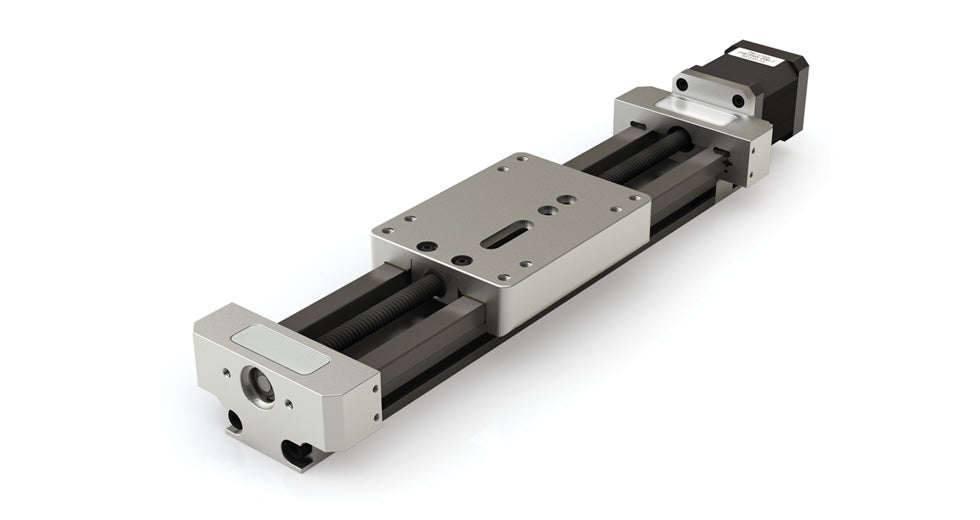
Lead Screw Driven Linear Actuator including a NEMA 17 motor. This actuator utilizes a Gliding Surface Technology™ (GST) carriage with a self-lubricating FrelonGold® underliner on a 140mm length rail with a tall profile. It features a 2mm screw lead and an anti-backlash screw nut. GST carriage with self-lubricating FrelonGold® liner..
$789.83
Belt-driven linear actuator with a 6,300mm body length, 55mm x 55mm base profile, and one carriage guided by a single recirculating ball profile rail with two runner blocks for high-speed, long-travel linear motion. This MTB Series actuator is engineered for medium payload applications and uses a steel-reinforced timing belt with..
$9,342.32
Belt-driven linear actuator with a 2250mm body length, 42mm x 42mm base profile, and one carriage guided by a single recirculating ball profile rail with two runner blocks for high-speed linear motion. This MTB Series actuator is engineered for lighter to medium payload applications and uses a steel-reinforced timing belt..
$3,267.05
Belt-driven linear actuator with a 1000mm body length, 42mm x 42mm base profile, and one carriage guided by a single recirculating ball profile rail with two runner blocks. This MTB Series actuator uses a steel-reinforced timing belt with adjustable tensioning and a 12mm left male drive shaft for motor or..
$2,149.79
Lead Screw Linear Actuator with a 16mm screw diameter, 1mm lead, and 300mm length, featuring a Round Anti-Backlash Nut and a NEMA 23 Single Stack Motor (56mm), pairing a quality screw made of stainless steel with a PTFE coating to minimize friction and prevent flaking with an innovative Anti-Backlash Nut..
$228.17
Non-Captive Lead Screw Linear Actuator 200mm long, 6mm screw diameter with a NEMA 14 Motor, Round Anti-Backlash Nut, 1mm lead, and the screw is made from precision-rolled 300 Series Stainless Steel and coated with PTFE to prevent flaking. The Round Constant Force™ Anti-Backlash nut uses a spring to maintain uniform..
$191.99
Belt-driven linear actuator with a 2500mm body length, compact 80mm x 80mm aluminum base profile, and one carriage supported by dual recirculating ball profile rail guides: one internal guide and one left-side external guide. The MTE design adds rigidity and load capacity compared with MTB actuators that use a single..
$7,075.96
Belt-driven linear actuator with a 1000mm body length, compact 80mm x 80mm aluminum base profile, and one carriage supported by dual recirculating ball profile rail guides: one internal guide and one left-side external guide. The MTE design adds rigidity and load capacity compared with MTB actuators that use a single..
$4,114.96
Belt-driven linear actuator with a 500mm length, 80mm x 80mm compact aluminum base profile, and one carriage supported by dual recirculating ball profile rail guides: one internal guide and one left-side external guide. The MTE design adds rigidity and load capacity more than MTB actuators that use a single profile..
$3,127.96
Belt-driven linear actuator with a 4000mm body length, 55mm x 55mm base profile, and one carriage supported by two recirculating ball profile rail guides: one internal guide and one external guide mounted on the left side. This MTE Series actuator uses a steel-reinforced timing belt with adjustable tensioning and a..
$7,408.00
Belt-driven linear actuator with a 1000mm body length, 55mm x 55mm base profile, and one carriage supported by two recirculating ball profile rail guides: one internal guide and one external guide mounted on the left side. This MTE Series actuator uses a steel-reinforced timing belt with adjustable tensioning and a..
$3,029.50
Belt-driven linear actuator with a 250mm body length, 55mm x 55mm base profile, and one carriage supported by two recirculating ball profile rail guides: one internal guide and one external guide mounted on the right side. This MTE Series actuator uses a steel-reinforced timing belt with adjustable tensioning and a..
$1,934.88
Belt-driven linear actuator with a 2500mm body length, 80mm x 80mm base profile, and one carriage supported by two external recirculating ball profile rail guides for maximum rigidity and load support within the MT actuator family. This MTS Series actuator uses a steel-reinforced timing belt with adjustable tensioning and a..
$6,965.26
Belt-driven linear actuator with a 1000mm body length, 80mm x 80mm base profile, and one carriage supported by two external recirculating ball profile rail guides for high rigidity and load support. This MTS Series actuator uses a steel-reinforced timing belt with adjustable tensioning and a 16mm female drive shaft for..
$4,051.51
Belt-driven linear actuator with a 500mm body length, 80mm x 80mm base profile, and one carriage supported by two external recirculating ball profile rail guides for high rigidity and load support. This MTS Series actuator uses a steel-reinforced timing belt with adjustable tensioning and a 16mm female drive shaft for..
$3,080.26
Belt-driven linear actuator with a 4000mm body length, 55mm x 55mm base profile, and one carriage supported by two external recirculating ball profile rail guides for high rigidity and load support. This MTS Series actuator uses a steel-reinforced timing belt with adjustable tensioning and a 16mm left male drive shaft..
$7,300.57
Belt-driven linear actuator with a 1000mm body length, 55mm x 55mm base profile, and one carriage supported by two external recirculating ball profile rail guides for high rigidity and load support. This MTS Series actuator uses a steel-reinforced timing belt with adjustable tensioning and a 12mm female drive shaft for..
$2,985.07
Belt-driven linear actuator with a 250mm body length, 55mm x 55mm base profile, and one carriage supported by two external recirculating ball profile rail guides for high rigidity and load support. This MTS Series actuator uses a steel-reinforced timing belt with adjustable tensioning and a 16mm diameter left male drive..
$1,906.19
Belt-driven linear actuator with a 2,250mm body length, 105mm x 105mm base profile, and one carriage guided by a single recirculating ball profile rail with two runner blocks for high-speed linear motion. This MTB Series actuator uses a steel-reinforced timing belt with adjustable tensioning and a 25mm left male drive..
$7,677.06
188 products

Linear Actuators

188 products
Linear Actuators Overview

A linear actuator is a mechanical device that combines a linear guide, drive mechanism, carriage-guidance system, and power source to produce controlled straight-line motion for moving or positioning a load. The drive mechanism—such as a ball screw, lead screw, belt, or fluid-powered piston—creates linear force, while the guidance system supports the carriage, controls its path, and resists side, moment, and cantilevered loads. Linear actuators are commonly classified as electric, mechanical, pneumatic, or hydraulic; electric and mechanical designs are often selected for controlled positioning, repeatability, clean operation, and integration with automated machinery.

PBC Linear designs guided belt-driven and screw-driven actuators powered by NEMA motors or hand cranks. Belt-driven actuators support long strokes and high speeds with low maintenance. Ball screw actuators provide high efficiency, load capacity, and positioning accuracy, while lead screw actuators offer quieter, more cost-effective motion with anti-backlash options for improved repeatability. Screw-driven configurations include external-nut actuators, where the screw rotates and a restrained nut travels along it; captive actuators, where the nut rotates and pushes a non-rotating screw in and out; and non-captive actuators, where the rotating nut travels along a screw that passes through the motor. Available configurations include multiple screw diameters, lead sizes, NEMA frame sizes, motor lengths, and actuator lengths to match specific force, speed, and travel requirements.

Carriage guidance is provided by either self-lubricating Gliding Surface Technology for low-maintenance operation in environments with dirt, heat, or vibration, or ball-bearing profile rails for greater moment capacity and cantilevered loads.

  • Guided belt-driven, ball screw, and lead screw actuator options
  • External-nut, captive, and non-captive screw configurations
  • NEMA motor-driven and hand-crank models
  • Multiple screw diameters, leads, motor lengths, and frame sizes
  • Choose Self-lubricating Gliding Surface Technology for dirt, heat, and vibration or ball-bearing profile rail guidance for higher moment and cantilevered loads
  • Load capacities up to 83,400N (18,750lb)
  • Stroke lengths up to 6,000mm (236in)
  • Miniature through heavy-duty actuator systems

Frequently Asked Questions

What is a linear actuator?
A linear actuator is a device that produces controlled straight-line motion by converting rotational or input force into linear movement. It is commonly used in automation, machinery, and positioning systems to move or position loads.
How does a linear actuator work?
A linear actuator works by converting motion from a motor, screw, or belt drive into linear movement. As the drive mechanism rotates or moves, it advances a carriage or rod along a guided path to produce controlled motion.
What are the main types of linear actuators?
The main types of linear actuators are electric, mechanical, pneumatic, and hydraulic. Electric and mechanical actuators are often preferred for their precision, cleanliness, and ease of integration, while pneumatic and hydraulic actuators are typically used for higher force applications.
What is the difference between a lead screw and a ball screw actuator?
Lead screw actuators use sliding contact between the screw and nut, making them quieter and more cost-effective, while ball screw actuators use rolling elements to reduce friction, providing higher efficiency, accuracy, and load capacity.
What is the difference between belt-driven and screw-driven actuators?
Belt-driven actuators are designed for long travel distances and higher speeds with lower cost and maintenance, while screw-driven actuators provide greater accuracy, stiffness, and load capacity for precise positioning applications.
When should a linear actuator be used instead of a cylinder?
Linear actuators are preferred when precise positioning, repeatability, and controlled motion are required, while pneumatic or hydraulic cylinders are typically used for simple extension and retraction with higher force but less control.
Do linear actuators require maintenance?
Maintenance depends on the design. Screw-driven actuators may require periodic lubrication, while some systems use self-lubricating materials or low-maintenance designs to reduce service requirements.
What factors should be considered when selecting a linear actuator?
Key factors include load capacity, speed, stroke length, required precision, environmental conditions, mounting configuration, and the type of drive mechanism used.
What provides guidance in a linear actuator?
Guidance in a linear actuator is provided by linear bearings or guide systems that support the carriage and maintain alignment. These may include sliding-contact guides for low maintenance or rolling-element guides for higher load and rigidity.
What are linear actuators used for?
Linear actuators are used in applications such as automation, material handling, packaging equipment, medical devices, and positioning systems where controlled linear motion is required.