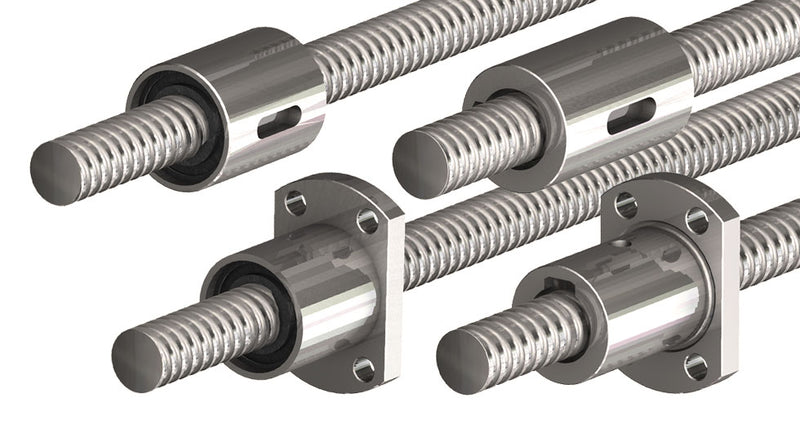
Lead screws and ball screws both convert rotational motion into linear movement by using helical screw threads to drive a nut along a linear axis. Lead screws rely on sliding contact between the screw thread and the nut, while ball screws use recirculating ball bearings that roll through matching helical grooves to reduce friction and improve efficiency.
Screw pitch is the distance between adjacent thread peaks, while screw lead is the distance the nut travels in one full rotation. On a single-start screw, pitch and lead are the same because there is only one continuous thread path. On a multi-start screw, two or more thread paths wrap around the screw, so lead equals pitch multiplied by the number of starts.
Lead screws are usually simpler, lower cost, and better suited for self-locking applications where back-driving must be limited. Ball screws are generally more efficient, faster, and better suited for high-precision or high-duty-cycle motion, but they may require a brake or other holding method to prevent back-driving. The right choice depends on load, speed, accuracy, efficiency, cost, and whether the screw drive will be paired with a linear guide for added support.
Lead Screws and Ball Screws both convert rotational motion into linear movement. The main difference between lead screws and ball screws is that ball screws rely on ball bearings to minimize friction and convert motion, while lead screws rely on low coefficients of friction between materials. When deciding between lead screws and ball screws, the choice largely depends on the specific requirements of the project. Use the chart and detailed information below to help decide on which product line is best suited for your application.
When it comes to precision and efficiency, ball screws reign supreme. Our Miniature Metric Ball Screw Assemblies exemplify this with their American-made craftsmanship and meticulous design. Their high efficiency results in less friction and heat generation, thus enhancing their lifespan.
The increased efficiency also requires less torque, which allows for the use of smaller motors and drive systems. Whether you opt for the cylindrical nut for a more compact assembly or the flange nut for easier installation, our ball screw assemblies promise unparalleled static axial load capacities and impeccable positional accuracy.
With polymer wipers to prevent debris ingress and options for preload to enhance rigidity, PBC Linear ball screws are the epitome of precision engineering. Browse and buy ball screws here.
We offer a diverse range of lead screw nuts, including Triangle, Round, Threaded, and Rectangle variants. We also offer our proprietary Constant Force Anti-Backlash Lead Screw Nuts to ensure reduced backlash over time. Each screw undergoes rigorous CNC roll threading and enhanced precision testing, ensuring standard accuracies that surpass industry norms.
Thanks to our Simplicity technology, our lead screws are self-lubricating, reducing maintenance needs. Additionally, lead screws do not require a holding brake in vertical applications making them versatile for different uses. With optional PTFE coating and superior machining, our lead screws boast extended lifespans and reduced friction. Browse and buy lead screws here.
Lead screws and ball screws commonly function as drive mechanisms for linear guides, delivering precise linear motion to carriages along high-precision rails. Below are three categories of these guides offered by PBC Linear:
Lead screws and ball screws both convert rotational motion into linear movement by using helical screw threads to drive a nut along a linear axis. Lead screws rely on sliding contact between the screw thread and the nut, while ball screws use recirculating ball bearings that roll through matching helical grooves to reduce friction and improve efficiency. Screw pitch is the distance between adjacent thread peaks, while screw lead is the distance the nut travels in one full rotation. On a single-start screw, pitch and lead are the same because there is only one continuous thread path. On a multi-start screw, two or more thread paths wrap around the screw, so lead equals pitch multiplied by the number of starts.
Lead screws are usually simpler, lower cost, and better suited for self-locking applications where back-driving must be limited. Ball screws are generally more efficient, faster, and better suited for high-precision or high-duty-cycle motion, but they may require a brake or other holding method to prevent back-driving. The right choice depends on load, speed, accuracy, efficiency, cost, and whether the screw drive will be paired with a linear guide for added support.