
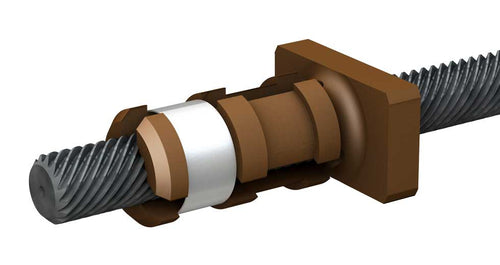


A lead screw, also called a leadscrew, is a precision threaded metal rod that converts rotary motion into controlled straight-line movement by using sliding contact between its threads and a correspondingly threaded, load-carrying nut to carry and position a load along a single linear axis. Unlike ball screws, which use recirculating ball bearings between the screw and nut to reduce friction, lead screws rely on direct sliding contact between the mating threads. Lead screw assemblies are available with different nut shapes and styles, including round, triangular, and rectangular configurations, while screws are offered in multiple diameters, thread profiles, pitches, leads, starts, and lengths for different loads, speeds, travel distances, and positioning requirements. Pitch is the distance between adjacent threads, lead is the distance the nut travels per screw revolution, and a start is one continuous helical thread. Pitch and lead are equal on a single-start screw, while lead equals pitch multiplied by the number of starts on a multi-start screw.
PBC Linear lead screw assemblies combine precision-rolled, PTFE-coated 300 Series stainless steel screws with self-lubricating, PTFE-infused Frelon® composite polymer nuts to reduce friction and wear while distributing loads across the engaged threads. Metric lead screws range from 6mm to 16mm in diameter with lead options from 1mm to 25mm, with corresponding inch configurations also available. Round, triangular, and rectangular nuts are offered in standard and Constant Force™ Anti-Backlash designs. Constant Force nuts use spring pressure to maintain thread engagement, with PBC Linear specifying 2–4 times less backlash over their operating life compared with standard nuts. Dynamic load capacity reaches 1.16kN (260lb), depending on configuration.
The leadscrews are precision-rolled and straightened in-house using a Galdabini PAS 4 STEP automated straightening machine to achieve published lead accuracy of approximately ±0.003in/ft (76µm/300mm). This collection features non-motorized lead screw assemblies organized by nut shape; motorized lead screw assemblies are available separately as screw-driven linear actuators.
- Lead screw assemblies for carrying and positioning loads along a single linear axis
- Precision-rolled 300 Series stainless steel lead screws
- PTFE-coated screws paired with self-lubricating Frelon® composite polymer nuts
- Metric screw diameters: 6mm, 8mm, 10mm, 12mm, and 16mm
- Lead options: 1mm to 25mm, with corresponding inch configurations available
- Round, triangular, and rectangular lead screw nut configurations
- Standard and Constant Force™ Anti-Backlash nut designs
- Constant Force™ nuts specified for 2–4 times less backlash over their operating life than standard nuts
- Dynamic load capacity up to 1.16kN (260lb), depending on configuration
- Published lead accuracy: approximately ±0.003in/ft (76µm/300mm)
- Non-motorized assemblies; motorized configurations available separately as screw-driven linear actuators
Our Blog Posts About Lead Screws:
- How Are Lead Screws Made
- How to Check Lead Screw Accuracy and Straightness
- Lead Screw Precision in Medical Applications
- Lead Screw Straightener at PBC Linear
- Non-Captive Lead Screw Linear Actuators
- How to Prevent Lead Screw Load Drift
- Components of Lead Screws, Ball Screws and Linear Rails
- 3 Methods of Connecting Lead Screws to Motors
- Glossary: What is Lead Screw Efficiency
Frequently Asked Questions
What is thread handedness and how does it relate to screw rotation direction?
What is the difference between a lead screw and screw lead?
What is an anti-backlash nut?
What is a leadscrew pitch, lead, and start?
What does PTFE coating do on a lead screw?
Can lead screws be motorized?
Why are both “lead screw” and “leadscrew” used for the same term?
Recently Viewed Products
- Choosing a selection results in a full page refresh.
- Opens in a new window.