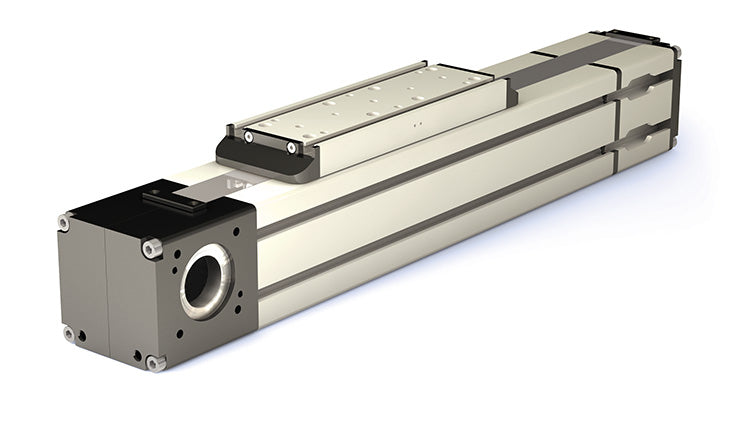
Belt Driven Linear Actuator with ball bearing guide

Belt-Driven Linear Actuators – MT Series with Ball Bearing Guides

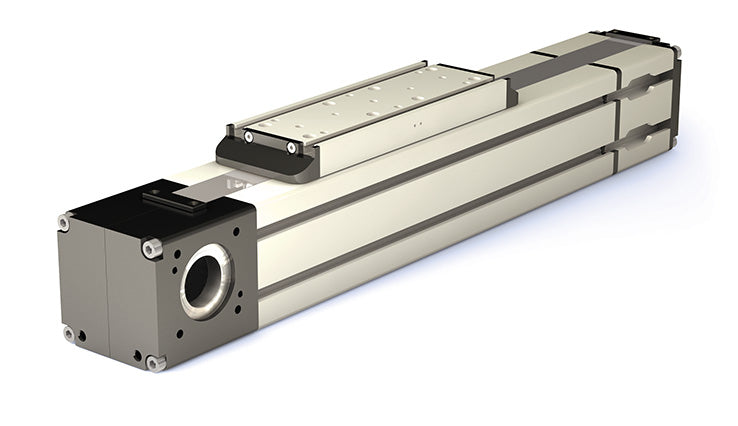
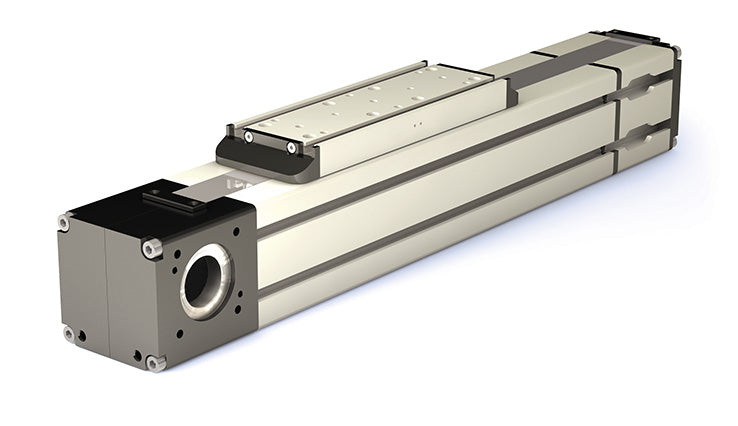
Belt-driven linear actuators use an electric motor to turn a toothed pulley that moves a flexible, steel-reinforced belt with evenly spaced teeth, called a timing belt. The belt moves the carriage quickly, smoothly, and repeatedly without slipping. Belt-driven systems are especially effective for long strokes because they do not depend on a long rotating screw, which can bend, vibrate, or whip at higher speeds. The MT Series includes three belt-driven configurations with different linear-guide arrangements. MTB actuators use one internal profile rail guide with two runner blocks, creating a compact design with the guidance system protected inside the aluminum profile. MTE actuators use one internal guide and one external guide, adding carriage support and moment-load capacity while maintaining a relatively compact structure. MTS actuators use two external profile rail guides, creating the widest support base and the greatest rigidity for heavier, wider, or off-centre loads. Because both MTS guides are mounted externally, they are more exposed to the surrounding environment, although the actuator body includes sealing features that help protect the belt-drive components. Built from lightweight, corrosion-resistant anodized aluminum, MT Series actuators are designed for fast, repeatable, long-travel motion in gantries, packaging equipment, material handling systems, pick-and-place machines, and other demanding automation applications.

More About Belt-Driven Linear Actuators – MT Series with Ball Bearing Guides

Ways to Order

Catalog Preview
Web Catalog Web Catalog Download PDF Download PDF Video Video Features Features
Motor Mount Kits

Motor Mount Kits

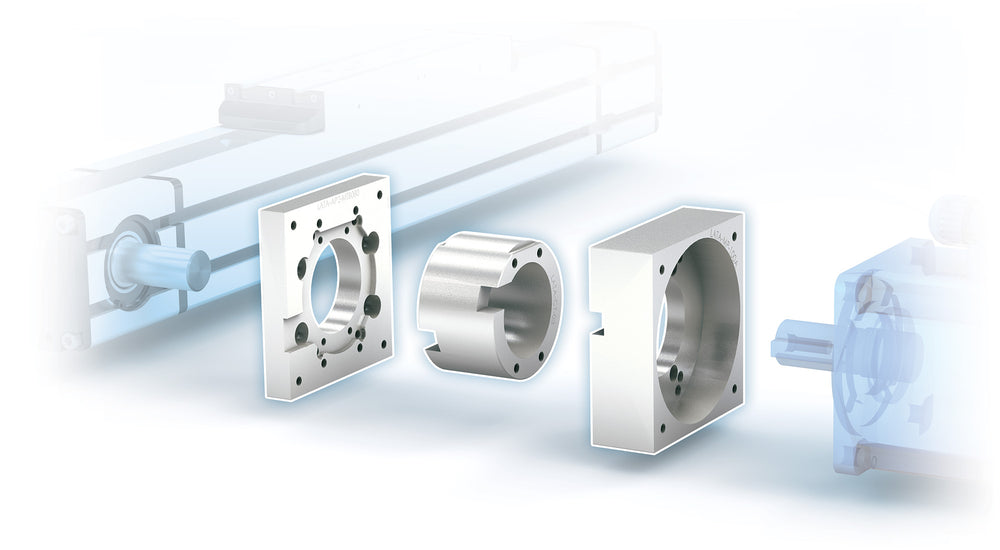
We now offer configurable motor mount kits with R + W Couplings for each MTB actuator. Use the configurator to select the optimal motor mount kit based on motor type and torque rating.

Browse Categories

Belt-Driven Linear Actuators – MT Series with Ball Bearing Guides

12 products
Close filters
12 products
Belt-driven linear actuator with a 6,300mm body length, 55mm x 55mm base profile, and one carriage guided by a single recirculating ball profile rail with two runner blocks for high-speed, long-travel linear motion. This MTB Series actuator is engineered for medium payload applications and uses a steel-reinforced timing belt with..
$9,342.32
Belt-driven linear actuator with a 2250mm body length, 42mm x 42mm base profile, and one carriage guided by a single recirculating ball profile rail with two runner blocks for high-speed linear motion. This MTB Series actuator is engineered for lighter to medium payload applications and uses a steel-reinforced timing belt..
$3,267.05
Belt-driven linear actuator with a 1000mm body length, 42mm x 42mm base profile, and one carriage guided by a single recirculating ball profile rail with two runner blocks. This MTB Series actuator uses a steel-reinforced timing belt with adjustable tensioning and a 12mm left male drive shaft for motor or..
$2,149.79
Belt-driven linear actuator with a 2,250mm body length, 105mm x 105mm base profile, and one carriage guided by a single recirculating ball profile rail with two runner blocks for high-speed linear motion. This MTB Series actuator uses a steel-reinforced timing belt with adjustable tensioning and a 25mm left male drive..
$7,677.06
Belt-driven linear actuator with a 1,250mm body length, 105mm x 105mm base profile, and one carriage guided by a single recirculating ball profile rail with two runner blocks for high-speed linear motion. This MTB Series actuator uses a steel-reinforced timing belt with adjustable tensioning and a 25mm female drive shaft..
$5,283.49
Belt-driven linear actuator with an 850mm body length, 105mm x 105mm base profile, and one carriage guided by a single recirculating ball profile rail with two runner blocks for high-speed linear motion. This MTB Series actuator is engineered for medium to high payload applications and uses a steel-reinforced timing belt..
$4,326.06
Robust belt-driven linear actuator with a base size of 080 x 080 mm and a body length of 6480mm, making it suitable for larger systems. It has a left male shaft with a diameter of 19 mm, ensuring compatibility with various setups. The actuator supports a single carriage and utilizes a..
$8,996.22
Belt-driven linear actuator with a 1,000mm body length, 80mm x 80mm base profile, and one carriage guided by a single recirculating ball profile rail with two runner blocks for high-speed linear motion. This MTB Series actuator is engineered for medium to high payload applications and uses a steel-reinforced timing belt..
$3,566.05
Belt-driven linear actuator with a 316mm body length, 80mm x 80mm base profile, and one carriage guided by a single recirculating ball profile rail with two runner blocks. This MTB Series actuator uses a steel-reinforced timing belt with adjustable tensioning and a 19mm left male drive shaft for motor or..
$2,396.65
Belt-driven linear actuator with a 1000mm body length, 55mm x 55mm base profile, and one carriage guided by a single recirculating ball profile rail with two runner blocks for high-speed linear motion. This MTB Series actuator is engineered for medium payload applications and uses a steel-reinforced timing belt with adjustable..
$2,628.16
Belt-driven linear actuator with a 240mm body length, 55mm x 55mm base profile, and one carriage guided by a single recirculating ball profile rail with two runner blocks. This MTB Series actuator uses a steel-reinforced timing belt with adjustable tensioning and a 16mm left male drive shaft for motor or..
$1,665.37
Belt-driven linear actuator with a 204mm body length, 42mm x 42mm base profile, and one carriage guided by a single recirculating ball profile rail with two runner blocks. This MTB Series actuator uses a steel-reinforced timing belt with adjustable tensioning and a 12mm left male drive shaft for motor or..
$1,438.32

Belt-Driven Linear Actuators – MT Series with Ball Bearing Guides

12 products

Belt-driven linear actuators convert the rotary motion of an electric motor into straight-line movement. The motor turns a toothed pulley that engages with a flexible, steel-reinforced belt with evenly spaced teeth, called a timing belt. The timing belt is connected to a carriage, which is the moving platform that supports and carries the load along the actuator. Because the teeth on the belt fit into matching grooves on the pulley, the belt can transfer motion without slipping, allowing the carriage to move quickly, smoothly, and repeatedly.

This drive system is especially well suited to long-stroke applications. Screw-driven actuators rely on a metal screw that rotates through the full length of travel. As the screw becomes longer, it can bend, vibrate, or whip at higher rotational speeds, limiting both stroke length and performance. A timing belt does not have the same restriction because it travels in a continuous loop around the drive and idler pulleys rather than spinning as a long shaft. This allows a belt-driven actuator to achieve faster movement over greater distances while maintaining a relatively lightweight design.

The MT Series includes MTB, MTE, and MTS actuator configurations, each using a different profile rail guide arrangement to support the carriage and control the load. The timing belt moves the carriage forward and backward, while the linear guides keep it aligned and resist forces that could cause it to tilt, twist, or shift during operation.

MTB actuators use one internal recirculating-ball profile rail guide with two runner blocks supporting the carriage. Placing the guide inside the aluminum profile helps protect it from the surrounding environment and creates a compact actuator for fast, long-travel motion. This configuration is well suited to applications with balanced loads and moderate moment forces.

MTE actuators use one internal profile rail guide and one external profile rail guide. The additional external guide gives the carriage a wider support structure than the MTB, improving rigidity, load capacity, and resistance to pitching, rolling, and yawing. This arrangement provides increased carriage support without requiring the full width of a design with two external guides.

MTS actuators use two external profile rail guides. Positioning both guides outside the actuator body creates the widest support base in the MT family, providing greater rigidity and stability for heavy, wide, or off-centre loads. This configuration offers the strongest resistance to moment loads and is well suited to large mounting plates and demanding automation systems. Because the guides are external, they are more exposed to dust and debris than the internal guide used on the MTB, so the operating environment and maintenance requirements should be considered during selection.

Built around lightweight, corrosion-resistant anodized aluminum profiles, MT Series actuators are available in multiple frame sizes and drive configurations. Features may include steel-reinforced timing belts, adjustable belt tensioning, recirculating-ball profile rail guides, rigid aluminum carriages, and flexible motor connection options. The series is designed for gantry systems, packaging equipment, material handling, pick-and-place automation, machine loading, transfer systems, and other applications requiring fast, repeatable motion over long distances.


MTB – One External Ball Guide

  • Four frame sizes: 42 × 42, 55 × 55, 80 × 80, and 105 × 105 mm
  • Maximum stroke: up to 6,700 mm (263.78 in)
  • Maximum horizontal payload: 7,500 N (1,686 lb)
  • One recirculating-ball profile rail guide with two runner blocks supporting the carriage
  • Compact, open design for fast, long-travel automation

MTE – One Internal and One External Ball Guide

  • Two profile sizes: 55 × 55 and 80 × 80 mm
  • Maximum stroke: up to 6,700 mm (263.78 in)
  • Maximum horizontal payload: 17,170 N (3,860 lb)
  • One internal and one external recirculating-ball profile rail guide
  • Greater carriage support, rigidity, and moment-load capacity than the MTB
  • The external guide can be positioned to suit the machine layout and load direction

MTS – Two External Ball Guides

  • Two profile sizes: 55 × 55 and 80 × 80 mm
  • Maximum stroke: up to 6,700 mm (263.78 in)
  • Maximum horizontal payload: 20,200 N (4,541 lb)
  • Two external recirculating-ball profile rail guides for the widest carriage support
  • Highest rigidity, load capacity, and moment-load resistance in the MT Series
  • Designed for heavy, wide, or off-centre loads, with external guides more exposed to the operating environment

Frequently Asked Questions

What is a belt-driven linear actuator?
A belt-driven linear actuator uses an electric motor to turn a toothed pulley. The pulley moves a timing belt connected to a carriage, causing the carriage and its load to travel in a straight line.
What is a timing belt?
A timing belt is a flexible, steel-reinforced belt with evenly spaced teeth. The teeth fit into matching grooves on the pulleys, allowing the belt to transfer motion without slipping.
What does it mean when the timing belt forms a loop?
The timing belt runs continuously around a drive pulley and an idler pulley, forming a closed loop. One straight section of the belt pulls the carriage, while the other section returns around the opposite side of the actuator.
What is the carriage on a linear actuator?
The carriage is the moving platform that supports the machine component or payload. It is connected to the timing belt and travels along the actuator as the motor turns the drive pulley.
What is actuator stroke?
Stroke is the usable distance the carriage can travel from one end of the actuator to the other. It is not the total actuator length or the total timing-belt length.
Why is the timing belt longer than the stroke?
The timing belt must form a complete loop around the drive and idler pulleys. The carriage travels along only one straight section of that loop, so the total belt length is considerably longer than the usable stroke.
Why are belt-driven actuators suitable for long strokes?
Belt-driven actuators do not require a long metal screw to rotate through the full travel distance. As a screw becomes longer, it can bend, vibrate, or whip at higher rotational speeds. A flexible timing belt moves around pulleys instead, allowing fast motion over longer distances without the same rotating-screw limitations.
What is a profile rail guide?
A profile rail guide is a precision linear guidance system that uses recirculating ball bearings to support and guide a carriage along a hardened rail. The ball bearings roll through tracks in the runner block, allowing smooth motion while carrying loads and resisting tilting, twisting, and sideways forces.
What is a running block in a linear actuator?
A running block, more commonly called a runner block, is the moving ball-bearing component that travels along the profile rail. It contains recirculating ball bearings that roll along the rail and circulate through internal return paths. One or more runner blocks connect the rail to the actuator carriage and help support the load.
What do the profile rail guides and runner blocks do?
The timing belt provides the force that moves the carriage, while the profile rail guides and runner blocks support the carriage and keep it aligned. They carry the load and resist pitching, rolling, yawing, and other moment forces that could cause the carriage to tilt or twist.
What is the difference between MTB, MTE, and MTS actuators?
MTB actuators use one internal profile rail guide with two runner blocks supporting the carriage. MTE actuators use one internal guide and one external guide for increased carriage support and moment-load capacity. MTS actuators use two external profile rail guides, creating the widest support base and the greatest rigidity for heavy, wide, or off-centre loads.
Why use internal profile rail guides?
Internal profile rail guides help keep the actuator compact and provide additional protection for the rail and runner blocks. This arrangement can be useful when space is limited or when the guidance components should be less exposed to the surrounding environment.
Why use external profile rail guides?
External profile rail guides can be spaced farther apart, giving the carriage a wider base of support. This improves rigidity, stability, and resistance to moment loads when moving heavy, wide, or off-centre payloads. The trade-off is that external rails are more exposed to dust, debris, and the operating environment.
What are moment loads?
Moment loads are forces that try to rotate or tilt the carriage instead of pushing directly along the actuator. They can cause pitching, rolling, or yawing when a load is wide, tall, heavy, or positioned away from the centre of the carriage.
What applications use MT Series actuators?
MT Series actuators are used in gantries, packaging machines, material handling systems, pick-and-place equipment, machine loading, transfer systems, and other industrial applications requiring fast, repeatable, long-travel linear motion.