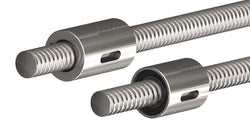
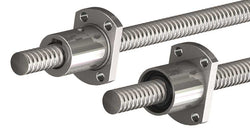
Ball screws are precision mechanical assemblies consisting of helically threaded, hardened steel rods and a mating nut with recirculating balls, designed to convert rotational motion into linear motion with minimal friction and high efficiency. Miniature Ball Screw Assemblies, made in the USA by PBC Linear, combine precision-rolled 1050 steel screw shafts (diameters 6mm, 8mm, 10mm; lead sizes 1mm, 2mm, 2.5mm) with cylindrical, flanged, or externally threaded cylindrical nuts for easy installation and removal in automation and precision motion systems. Featuring a multi-liner ball return system, the nuts ensure smooth, efficient motion with consistent lead accuracy, outperforming lead screws in durability and precision under high loads. Two nut fit options (Standard & Transitional) enhance rigidity and positional accuracy, while polymer wipers at each nut end prevent debris ingress, extending service life in harsh environments like lab automation and medical devices. With a maximum static axial load capacity of 2.144 kN (482 lb), they support demanding applications, and shorter project lead times. Compatible with NEMA 08–23 motors, select assemblies integrate PowerPlus technology for 25–40% increased torque, making them ideal for robotics, CNC machinery, and industrial automation.
- More durable than lead screws with consistent lead accuracy
- Shorter delivery times from the factory west of Chicago
- Utilizes a multi-liner ball return system
- Static axial load: 2.144 kN (482 lb)
For ball screw motor assemblies, click here
Read about the difference between ball screws and lead screws
Frequently Asked Questions
What is a ball screw?
A ball screw converts rotary motion into linear motion using recirculating ball bearings between the screw and nut. This reduces friction and supports efficient, accurate travel.
What is ball screw lead?
Lead is the linear distance the nut travels during one full screw rotation. A smaller lead provides finer positioning, while a larger lead produces more travel per rotation.
What is a ball screw journal?
A journal is a machined section at one or both screw ends. It is shaped to fit bearings, couplings, motors, support blocks, or other mounting components.
What is ball screw end machining?
End machining shapes one or both screw ends for installation. It may create journals, shoulders, threads, retaining-ring grooves, or other features needed for bearings, couplings, motors, and supports.
What is end-block machining?
End-block machining prepares the screw ends to fit specified support blocks, bearing housings, or mounting assemblies.
What is the difference between standard and custom ball screw machining?
Standard machining uses established screw-end dimensions for common supports and components. Custom machining creates screw-end features to match the dimensions of a specific machine or mounting system.
What is ball screw backlash?
Backlash is a small amount of looseness between the ball screw and nut. When rotation reverses, the screw may move slightly before the nut begins traveling in the opposite direction.
What is ball screw preload?
Preload applies slight internal pressure between the nut, balls, and screw to reduce or eliminate backlash. It can improve rigidity and positioning accuracy but may increase friction and required torque.
What is a standard-fit ball screw nut?
A standard-fit nut allows a specified amount of backlash and normally has no intentional preload. It is suitable for applications that do not require the lowest possible play.
What is a transitional-fit ball screw nut?
A transitional-fit nut has less play than a standard-fit nut and may range from very low backlash to slight preload. It provides more responsive direction changes and improved positioning.
What is a cylindrical ball screw nut?
A cylindrical nut has a round body designed to fit inside a matching housing. It can provide a more compact assembly than a flanged nut.
What is a flanged ball screw nut?
A flanged nut includes a mounting flange with holes for fastening the nut directly to a carriage, plate, or other machine component.
What is an externally threaded ball screw nut?
An externally threaded nut has screw threads around part of its outside surface. These threads allow the nut to mount directly into a matching internally threaded housing or component.
What does a ball screw nut keyway do?
A keyway is a slot in the nut that works with a matching key to prevent the nut from rotating while it travels along the screw.
What is a ball-return system?
A ball-return system guides the ball bearings back through the nut after they complete their load-carrying path, allowing continuous recirculation and smooth linear motion.
What do polymer wipers do on a ball screw nut?
Polymer wipers help prevent dust and debris from entering the nut while helping retain lubrication around the ball bearings.
What is static axial load capacity?
Static axial load capacity is the maximum axial load the ball screw assembly can support while stationary without permanent damage to the screw, nut, or ball tracks.
What does ball screw diameter mean?
Ball screw diameter is the nominal outside diameter of the threaded screw. It affects load capacity, rigidity, available nut size, and installation space.