

Ball Screws and Lead Screws
Ways to Order


Browse Categories

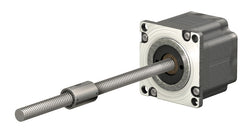
Ball Screw Linear Actuators
| MAX Horizontal Payload | 2.144 kN (482 lb) |
| MAX Stroke | 1650 mm (65 inches) |
| MAX Rotational Speed | Up to 5,000* RPM |
| * For faster options, contact factory |


Lead Screw Linear Actuators
| MAX Horizontal Payload | 1.16 kN (260 lb) |
| MAX Stroke | 1650 mm (65 inches) |
| MAX Rotational Speed | Up to 2,500* RPM |
| * For faster options, contact factory |


Ball screws and lead screws are threaded steel rods that convert rotary motion into linear motion using a matching load-carrying nut that moves and positions a load along a straight axis. Ball screws use recirculating ball bearings that roll between helical raceway grooves in the rod and nut to reduce friction and provide high efficiency, accuracy, and load capacity, while lead screws use direct sliding contact between matching threads on the rod and nut for simpler, more cost-effective linear motion. In a typical system, the rod rotates while the nut travels axially without rotating; other designs rotate the nut while the rod moves axially. The direction of travel depends on thread handedness and rotation direction, while screw lead—the axial distance traveled per full revolution—and rotational speed determine how far and how fast the nut or rod moves.
PBC Linear ball screws use helical grooves to guide recirculating ball bearings through the nut, providing low-friction linear motion with high efficiency and accurate, repeatable travel. Made in the USA from precision-rolled 1050 steel, PBC Linear ball screws are available in 6mm, 8mm, and 10mm diameters with 1mm, 2mm, and 2.5mm leads, providing six metric diameter-and-lead combinations. Matching ball screw nuts are available in cylindrical and flanged configurations and use a multi-liner ball-return system to continuously recirculate the balls, with polymer seals helping protect the internal rolling elements from contamination.
Lead screws use direct sliding contact between the threads of a steel rod and a matching nut to convert rotary motion into linear movement. PBC Linear PTFE-coated stainless steel lead screws provide corrosion resistance, low friction, low wear, and minimal coating flaking. Available in 6mm, 8mm, 10mm, 12mm, and 16mm diameters with a wide range of lead options, they can be paired with round, triangular, rectangular, or Constant-Force Anti-Backlash nuts to minimize axial play. Select PBC Linear ball screw and lead screw configurations are compatible with NEMA 08–23 motors or hand cranks, creating screw-driven linear actuators for compact positioning, adjustment, and automation applications.
- Ball Screw Diameters: 6, 8, and 10mm
- Ball Screw Lead Sizes: 1, 2, and 2.5mm
- Ball Screw Nut Fit: Standard and Transitional
- Ball Screw Nut Profiles: cylindrical, flanged and externally threaded cylindrical nuts
- Lead Screw Diameters: 6, 8, 10, 12, and 16 mm
- Lead Screw Lead Sizes: 1, 2, 2.5, 4, 5, 6, 8 , 10, 12, and 25mm
- Lead Screws have round and triangular nuts
- Lead Screws made of stainless steel with a PTFE coating to prevent flaking
More Features of Ball Screw & Lead Screw Assemblies
Frequently Asked Questions
What is a screw lead?
What is the difference between screw pitch, screw start and screw lead?
What does axial movement mean?
What does NEMA mean?
Recently Viewed Products
- Choosing a selection results in a full page refresh.
- Opens in a new window.