

Steel Rail Plus Linear Guides
Ways to Order


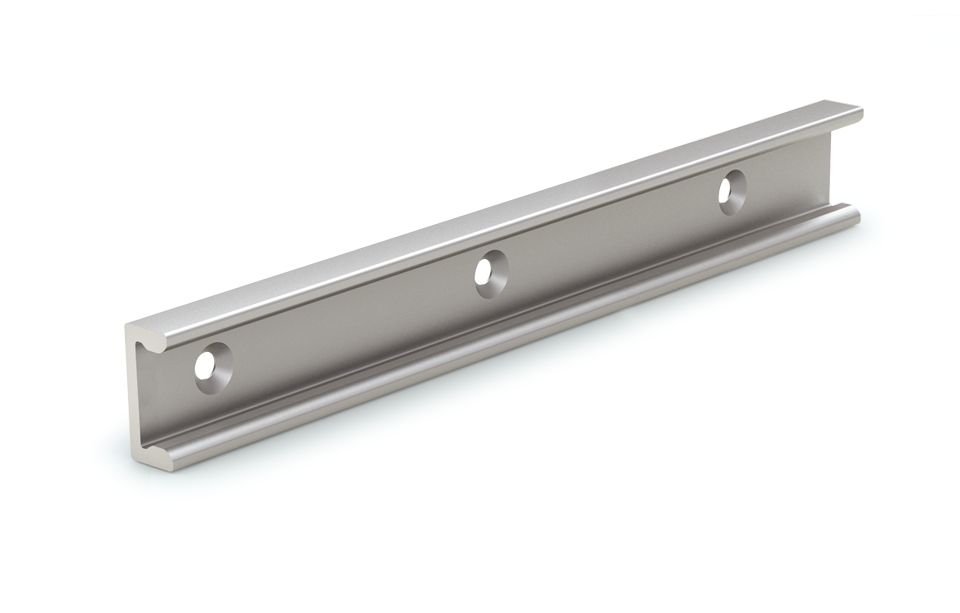


Steel Rail Plus linear guides are cam roller linear guide systems designed for parallel-rail applications where installation tolerances or structural variation can cause misalignment. PBC Linear Steel Rail Plus uses cold-drawn, zinc-plated steel rails up to 5,000 mm long with aluminum carriages containing three to six concentric and eccentric cam rollers. Concentric rollers provide the primary fixed rolling support, while eccentric rollers allow contact and preload to be adjusted for reduced play, greater rigidity, and smooth travel.
Steel Rail Plus is available with guiding, floating, and rotating linear guide carriages that work together to compensate for misalignment in two planes. The guiding carriage establishes the primary motion path and acts as the reference carriage in the system, carrying the load while controlling the direction of travel along its rail. The floating carriage allows a small amount of lateral movement across the rail, absorbing variations in the spacing between two parallel rails rather than forcing both sides of the assembly into a rigid position that could cause binding. The rotating carriage compensates for angular misalignment when parallel rails are not perfectly aligned in the same plane. This is called coplanar misalignment. It does not make a full rotation; instead, it permits a very small, momentary partial pivot when necessary, allowing the carriage and its cam rollers to remain properly seated on the rail without forcing the system to bind. Together, the three carriage types allow the moving structure to follow the guiding rail while accommodating lateral and angular mounting variation on the secondary rail.
Adjustable preload provides additional control over carriage rigidity and running clearance. Integrated oil-soaked felt wipers continuously lubricate the steel raceways, while scraper blades help remove dust and debris before contaminants reach the cam rollers. Steel Rail Plus supports dynamic loads up to 20,520 N and combines high load capacity with smooth, low-friction motion and built-in alignment compensation. Its long rail lengths and flexible carriage configurations make it well suited for material handling, robotics, automation, machine building, gantries, and other applications using two parallel linear rails.
Torx fasteners are screws or bolts with a six-point star-shaped drive designed to transfer torque efficiently from the tool to the fastener. The Torx profile provides broad contact between the driver and screw, helping reduce cam-out and allowing higher torque with less risk of damaging the drive recess. For Steel Rail products, PBC Linear offers compatible Torx fasteners as separately purchased mounting hardware.
- Cam roller linear guide system designed to compensate for misalignment in parallel-rail applications
- Guiding carriages establish the primary motion path and act as the system reference
- Floating carriages allow slight lateral movement to compensate for variations in rail spacing
- Rotating carriages permit a small partial pivot to accommodate angular or coplanar misalignment
- Three to six concentric and eccentric cam rollers per aluminum carriage with adjustable preload
- Cold-drawn, zinc-plated steel rails available in lengths up to 5,000 mm
- Dynamic load capacity up to 20,520 N with integrated lubrication and debris protection
Frequently Asked Questions
What is coplanar misalignment in a linear guide system?
What problem does a floating carriage solve in a parallel linear rail system?
Why would a linear guide system use both guiding and floating carriages?
Why does a rotating carriage only pivot slightly instead of fully rotating?
How does Steel Rail Plus help prevent binding between parallel linear rails?
Can guiding, floating, and rotating carriages be used together in the same linear guide system?
What is the difference between lateral misalignment and coplanar misalignment?
Recently Viewed Products
- Choosing a selection results in a full page refresh.
- Opens in a new window.