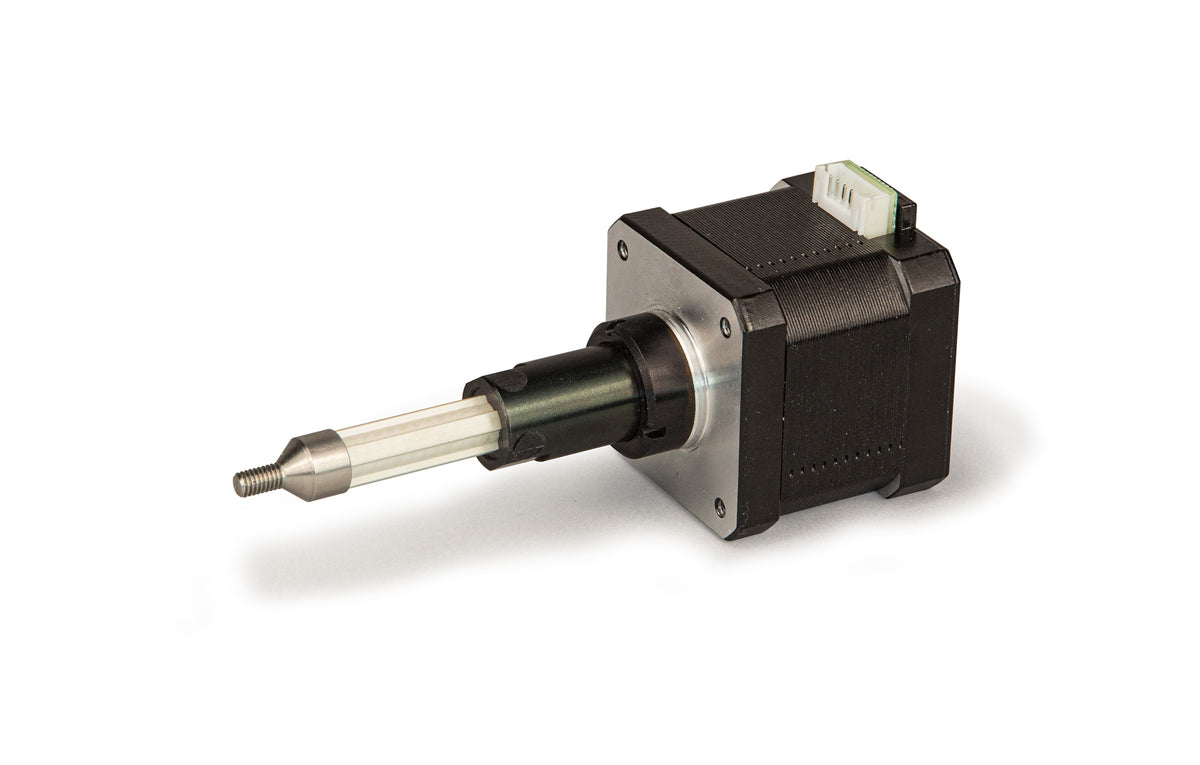
Captive Lead Screw Linear Actuator Motor Assembly

Captive Lead Screw Linear Actuators

Captive lead screw linear actuators are integrated motorized assemblies that use a non-rotating lead screw to move and accurately position loads along a straight path. An internal rotating drive nut converts motor rotation into linear motion, causing the lead screw to extend or retract from the motor housing to push or pull the attached load. One end of the screw remains captured within the actuator, providing mechanical stability while limiting the available stroke length. This configuration makes captive lead screw actuators particularly suitable for compact applications requiring short, controlled linear movements and accurate load positioning.

Available in five NEMA frame sizes—08, 11, 14, 17, and 23—these captive lead screw actuators feature PTFE-coated screw and nut threads to reduce friction, minimize wear, and resist contamination. Integrated angular contact bearings within the motor housing increase thrust capacity, reduce deflection, and control runout. Factory-preloaded bearings minimize axial clearance and help maintain consistent positioning accuracy and low backlash throughout the actuator's service life. Optional Smart Motor Technology can increase output torque by up to 50%, enabling faster cycle times and improved productivity without increasing the actuator footprint.

More About Captive Lead Screw Linear Actuators

Ways to Order

Catalog Preview
Web Catalog Web Catalog Download PDF Download PDF Video Video Features Features

Browse Categories

5 products
Captive Pusher Lead Screw Linear Actuator with a NEMA 08 motor, 0.138" screw diameter, 0.024" lead, and 25.4mm stroke length for compact, precise linear motion applications. In this captive internal actuator design, the lead screw is retained within the motor assembly while an integrated internal nut mechanism drives the non-rotating..
$214.22
Captive Pusher Lead Screw Linear Actuator with a NEMA 17 motor, 1/4" screw diameter, 1/2" lead, and 25.4mm stroke length for compact, precise linear motion applications. In this captive internal actuator design, the lead screw is retained within the motor assembly while an integrated internal nut mechanism drives the non-rotating..
$183.88
Captive Pusher Lead Screw Linear Actuator with a NEMA 11 motor, 0.188" screw diameter, 0.025" lead, and 25.4mm stroke length for compact, precise linear motion applications. In this captive internal actuator design, the lead screw is retained within the motor assembly while an integrated internal nut mechanism drives the non-rotating..
$191.82
Captive Pusher Lead Screw Linear Actuator with a NEMA 14 motor, 1/4" screw diameter, 1/2" lead, and 25.4mm stroke length for compact, precise linear motion applications. In this captive internal actuator design, the lead screw is retained within the motor assembly while an integrated internal nut mechanism drives the non-rotating..
$203.37
Captive Pusher Lead Screw Linear Actuator with a NEMA 23 motor, 3/8" screw diameter, 1/5 inch lead, and 25.4mm stroke length for compact, precise linear motion applications. In this captive internal actuator design, the lead screw is retained within the motor assembly while an integrated internal nut mechanism drives the..
$227.28

Captive Lead Screw Linear Actuators

5 products

Captive lead screw linear actuators are integrated motorized assemblies that use a non-rotating lead screw to move and accurately position loads along a straight path. An internal rotating drive nut converts motor rotation into linear motion, causing the lead screw to extend or retract from the motor housing to push or pull the attached load. One end of the screw remains captured within the actuator, providing mechanical stability while limiting the available stroke length. This configuration makes captive lead screw actuators particularly suitable for compact applications requiring short, controlled linear movements and accurate load positioning.

Available in five NEMA frame sizes—08, 11, 14, 17, and 23—these captive lead screw actuators feature PTFE-coated screw and nut threads to reduce friction, minimize wear, and resist contamination. Integrated angular contact bearings within the motor housing increase thrust capacity, reduce deflection, and control runout. Factory-preloaded bearings minimize axial clearance and help maintain consistent positioning accuracy and low backlash throughout the actuator's service life. Optional Smart Motor Technology can increase output torque by up to 50%, enabling faster cycle times and improved productivity without increasing the actuator footprint.


  • Five frame sizes: NEMA 08, 11, 14, 17, and 23
  • Multiple lead screw and nut combinations available per frame size
  • Available with standard and anti-backlash nuts
  • Three nut styles offer design flexibility: round, square and triangular
  • Larger bearing design increases thrust capacity and service life
  • Preloaded bearings eliminate axial play for improved positioning accuracy
  • Optional Smart Motor Technology for up to 50% more torque

Frequently Asked Questions

What is a captive lead screw linear actuator?
A captive lead screw linear actuator is a motorized assembly that uses a non-rotating lead screw to move and accurately position loads along a straight path.
How does a captive lead screw actuator work?
A motor rotates an internal drive nut that moves a non-rotating lead screw forward or backward. The screw extends or retracts from the motor housing to push or pull an attached load.
What is the difference between captive and non-captive lead screw actuators?
Captive actuators use a non-rotating lead screw that extends and retracts from the motor housing. Non-captive lead screw linear actuators are motorized assemblies that use a lead screw passing completely through the motor, with a threaded drive nut integrated into the motor rotor, to move and accurately position loads. In one configuration, the lead screw is supported at both ends and rotates without moving linearly, allowing the motor assembly and its attached load to travel along the screw. Alternatively, the motor can remain stationary while its rotating internal nut drives a non-rotating lead screw through the motor housing, moving and positioning a load attached to the screw's end. Both configurations accommodate longer travel distances and provide flexible mounting options. Unlike captive lead screw actuators, which use an internally guided, non-rotating screw that extends and retracts from the motor housing for shorter push-pull strokes, non-captive actuators allow the screw to pass entirely through the motor. They also differ from external-nut lead screw actuators, which use a rotating screw extending from one side of a stationary motor and a separate, non-rotating, load-carrying nut that travels along the screw to move and position the load.
How does an external lead screw actuator work?
An external lead screw actuator uses a rotating screw and an external load-carrying nut. The screw rotates without moving linearly, causing the non-rotating nut to travel along its threads and move the attached load.
What are captive lead screw actuators used for?
Captive lead screw actuators are used for short-stroke linear movement and positioning in automation, medical equipment, laboratory instruments, and compact machinery.
What NEMA sizes are available for captive lead screw actuators?
Captive lead screw actuators are available in NEMA frame sizes 08, 11, 14, 17, and 23.
Why do captive lead screw actuators have limited travel lengths?
The non-rotating lead screw must remain partially captured inside the actuator housing, limiting how far it can extend or retract.
What are the benefits of PTFE-coated lead screws?
PTFE coatings reduce friction and wear between the lead screw and nut threads, improving operating efficiency and helping protect against contamination.
How do angular contact bearings improve actuator performance?
Angular contact bearings support axial loads, reduce deflection, and help control runout. Factory preload minimizes axial clearance for consistent positioning accuracy.
What is backlash in a lead screw actuator?
Backlash is lost motion caused by clearance between the lead screw and nut threads when the direction of movement reverses. Reducing backlash improves positioning consistency.
What is Smart Motor Technology in lead screw actuators?
Smart Motor Technology is an optional motor control upgrade that can increase output torque by up to 50%, supporting faster cycle times without increasing the actuator footprint.