What Is a Cam Follower?

collection of cam and yoke followers

Typical cam followers used in linear motion applications. Variations include stud-type and yoke-type designs, as well as different outer ring materials and profiles depending on load and environment.

A cam follower is a rolling-element bearing designed to follow the surface of a cam, track, or rail. In linear motion applications, cam followers are often used to guide movement along a straight or contoured path while supporting load with low friction.

Unlike standard ball bearings that are mounted inside housings, cam followers are self-contained guidance elements. They feature a thick outer ring that rolls directly on a guiding surface, allowing them to function as both the bearing and the rolling interface. This simplicity is one of their key advantages: fewer components, fewer interfaces, and fewer opportunities for misalignment-related failure.


Why Cam Followers Are Used in Linear Motion

Cam followers are commonly selected when the application values robustness and simplicity over extreme precision. Typical reasons include:     

  • Compact designs where full linear guide systems are impractical
  • Predictable loading with known directions and magnitudes
  • Repetitive or continuous motion along straight or formed paths
  • Lower system cost and integration effort compared to precision rails

From a lifecycle perspective, cam followers often perform well in environments where contamination, shock loading, or minor misalignment would shorten the life of more delicate guidance systems. Their rolling contact reduces friction and wear, while the thick outer ring tolerates surface imperfections in the track.

cam followers shown

Basic Construction and Operating Principles

Most cam followers share a common internal structure:

  • A thick-walled outer ring that rolls on the cam or rail
  • Rolling elements (typically needle rollers) between the inner and outer rings
  • An inner ring or stud that mounts to the machine structure
  • Seals and lubrication to support long service life

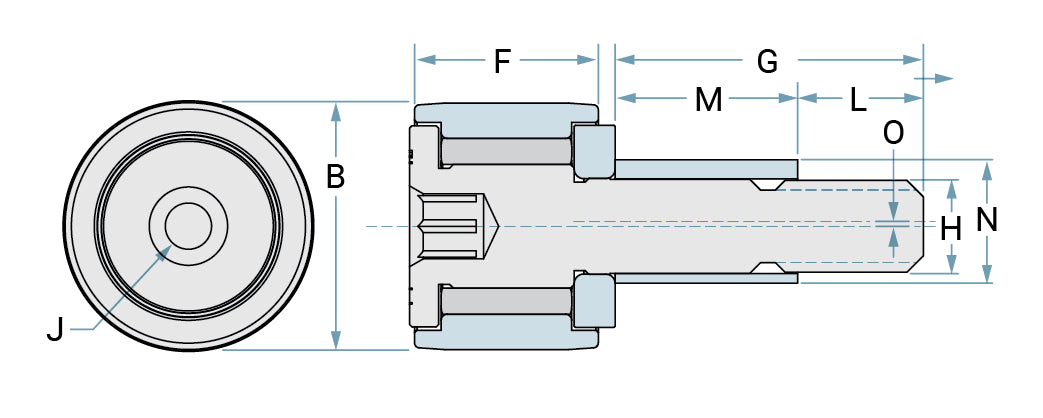
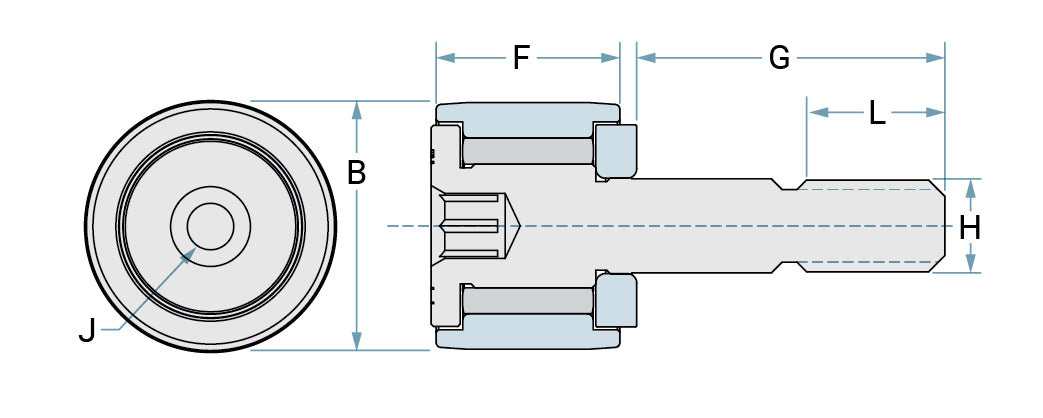
The outer ring carries the contact stress, while the rolling elements minimize friction. Because the outer ring is significantly thicker than a standard bearing raceway, cam followers can withstand higher contact loads and occasional shock without surface damage. See catalog for full dimensional drawings.

dimensional drawing

Stud-Type vs. Yoke-Type Cam Followers

One of the most visible distinctions among cam followers is how they are mounted. This affects stiffness, load capacity, and overall system reliability.

stud follower

Stud-Type Cam Followers

Stud-type cam followers have an integral threaded stud that mounts cantilevered into a single support surface. This design is compact and easy to install, making it attractive for lighter-duty applications or space-constrained machines.

Key benefits:

  • Simple mounting with minimal surrounding structure
  • Compact footprint
  • Lower initial cost

Tradeoff: Because the stud is unsupported on one end, it experiences bending under load. As loads increase, stud deflection can reduce stiffness and shorten bearing life.

An image of a yoke follower

Yoke-Type Cam Followers

Yoke-type cam followers use a through-bore inner ring mounted on a shaft or pin and supported on both sides by a yoke or frame.

Key benefits:

  • Higher load capacity for a given bearing size
  • Increased stiffness due to supported mounting
  • Reduced bending stress and longer service life

This configuration is often preferred in industrial automation, material handling, and custom machinery where durability and uptime matter more than minimizing component count.

Concentric vs. Eccentric Cam Followers

Beyond mounting style, cam followers are also distinguished by how the inner ring or stud is positioned relative to the outer ring. This affects alignment, adjustability, and load sharing in linear motion systems.
Concentric cam follower

Concentric Cam Followers

In a concentric cam follower, the centerline of the stud or inner ring is perfectly aligned with the centerline of the outer ring. This means there is no built-in adjustment—the rolling surface runs exactly where it is mounted.

Why use concentric cam followers:

  • Maximum load capacity and stiffness
  • Simplest, most robust configuration
  • Best choice when alignment is well controlled

Concentric cam followers are typically used when the machine structure is rigid and accurately machined, or when adjustment is not required after assembly. Fewer adjustable features often translate into longer, more predictable service life.

Eccentric cam follower

Eccentric Cam Followers

Eccentric cam followers have an offset between the stud (or inner ring) and the outer ring. By rotating the eccentric portion during installation, the position of the outer roller can be adjusted relative to the mounting surface.

Why use eccentric cam followers:

  • Allows fine adjustment during assembly
  • Compensates for tolerance stack-up or rail variation
  • Enables preload or clearance tuning between opposing rollers

This adjustability is especially valuable in systems using multiple cam followers on parallel rails, helping eliminate play and improve load sharing.

Tradeoff: The offset geometry slightly reduces load capacity compared to a concentric cam follower of the same size. In most applications, this is an acceptable compromise for the added flexibility and ease of alignment.

How These Choices Affect System Performance

Selecting between stud-type vs. yoke-type and concentric vs. eccentric cam followers is less about right or wrong and more about managing risk:

  • Higher loads and longer life favor yoke-type, concentric designs
  • Easier assembly and field adjustment favor eccentric designs
  • Simpler machines with controlled tolerances favor stud-type, concentric designs

Understanding these tradeoffs early in the design process helps prevent issues such as uneven wear, premature bearing failure, or excessive maintenance effort later on.

Cam Followers vs. Linear Guides

Cam followers are not a replacement for precision linear guides when applications demand high accuracy, low deflection under varying loads, or ultra-smooth motion. Profile rails and linear bearings excel in those scenarios.

However, cam followers often win when the priority is:

  • Mechanical simplicity
  • Durability in harsh or dirty environments
  • Lower total cost of ownership
  • Confidence that the system will keep running with minimal attention

Practical Takeaway

Linear motion cam followers offer a balance of load capacity, durability, and simplicity that makes them a reliable choice in many industrial machines. By understanding mounting styles (stud vs. yoke) and alignment options (concentric vs. eccentric), designers can tailor performance without over-engineering the system.

The real benefit is not just motion—it is predictable performance over time, reduced integration risk, and confidence that the machine will do its job cycle after cycle.

View all the cam followers available at PBC Linear: Cam Rollers and Cam Followers | PBC Linear.

Cite This Page

Source: PBC Linear - “What Is a Cam Follower?”
https://pbclinear.com/blogs/blog/what-is-a-cam-follower
Last updated: February 2026
Methodology: Content is based on standard linear motion engineering principles and PBC Linear product documentation, including catalogs, dimensional drawings, and application guidance. Descriptions are intended for general design comparison; refer to current PBC Linear specifications for exact ratings and dimensions.