
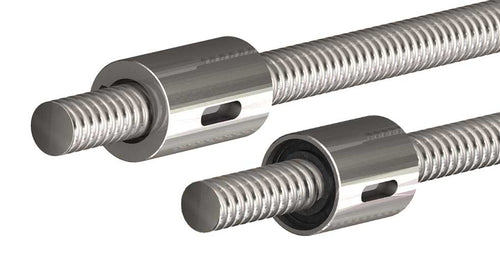
Cylindrical Nut Ball Screw Assemblies

Ball Screws with Cylindrical Nuts

Ball screws with cylindrical nuts use a round, non-flanged ball nut that fits inside a matching housing for a more compact assembly than many flanged-nut designs. PBC Linear miniature ball screw assemblies are available with 6mm, 8mm, and 10mm screw diameters and 1mm, 2mm, or 2.5mm leads, depending on screw size. Lead is the axial distance the nut travels during one complete screw rotation; smaller leads support finer positioning, while larger leads provide more travel per revolution. The steel screw shafts are precision-rolled for consistent lead accuracy over the screw length. Each cylindrical nut contains a multi-liner ball-return system that guides the recirculating balls through the nut for continuous, low-friction motion. Polymer wipers at both ends help block debris and retain lubrication around the internal ball tracks. Standard-fit nuts provide no more than 0.05mm backlash, while transitional-fit options reduce play and may apply slight preload for greater rigidity and more responsive direction changes. Assemblies support static axial loads up to 2.144kN (482lb), depending on the selected size and configuration. Custom screw lengths, nut fits, and journal machining are available through the custom configurator. A journal is the machined section at one or both screw ends that fits a bearing, coupling, motor, support block, or other mounting component.

More About Ball Screws with Cylindrical Nuts

Ways to Order

Catalog Preview
Web Catalog Web Catalog Download PDF Download PDF Video Video Features Features
22 products
Miniature ball screw assembly, 8mm diameter, 2mm lead, 150mm length — delivering faster travel per revolution while maintaining precision in a compact form factor. BSR series with Grade 10 accuracy class for reliable linear motion in space-constrained applications. 2mm lead offers a compromise between speed and positional accuracy. 150mm length..
$131.21
Miniature ball screw assembly with a cylindrical nut, featuring an 8 mm diameter, 2 mm lead, and 250 mm length for compact, efficient linear motion with precise, fast positioning. Grade 10 accuracy class. Equipped with wipers. The 2 mm lead is suitable for rapid adjustments. Durable, corrosion-resistant design supports high..
$141.01
22 products

Ball Screws with Cylindrical Nuts

22 products

Ball screws with cylindrical nuts use a round, non-flanged ball nut that fits inside a matching housing for a more compact assembly than many flanged-nut designs. PBC Linear miniature ball screw assemblies are available with 6mm, 8mm, and 10mm screw diameters and 1mm, 2mm, or 2.5mm leads, depending on screw size. Lead is the axial distance the nut travels during one complete screw rotation; smaller leads support finer positioning, while larger leads provide more travel per revolution. The steel screw shafts are precision-rolled for consistent lead accuracy over the screw length.

Each cylindrical nut contains a multi-liner ball-return system that guides the recirculating balls through the nut for continuous, low-friction motion. Polymer wipers at both ends help block debris and retain lubrication around the internal ball tracks. Standard-fit nuts provide no more than 0.05mm backlash, while transitional-fit options reduce play and may apply slight preload for greater rigidity and more responsive direction changes. Assemblies support static axial loads up to 2.144kN (482lb), depending on the selected size and configuration. Custom screw lengths, nut fits, and journal machining are available through the custom configurator. A journal is the machined section at one or both screw ends that fits a bearing, coupling, motor, support block, or other mounting component.

  • Compact cylindrical ball nut for installation inside a matching housing
  • More space-efficient than many flanged-nut designs
  • Available in 6mm, 8mm, and 10mm screw diameters
  • Lead options of 1mm, 2mm, and 2.5mm, depending on screw size
  • Precision-rolled steel screw shafts for consistent lead accuracy
  • Multi-liner ball-return system for continuous ball recirculation
  • Polymer wipers at both nut ends help block debris and retain lubrication
  • Standard-fit nut: no more than 0.05mm backlash
  • Transitional-fit nut available for reduced play and optional slight preload
  • Static axial load capacity: up to 2.144kN (482lb)
  • Custom lengths, nut fits, and journal machining available through the custom configurator
  • A journal is the machined screw-end section that fits bearings, couplings, motors, support blocks, or other mounting components

Frequently Asked Questions

What is the difference between cylindrical and flanged ball screw nuts?
A cylindrical ball screw nut has a round body designed for installation inside a machine housing. A flanged nut has an external flange with bolt holes for direct attachment to a plate, carriage, or mounting block.
Why are cylindrical ball screw nuts used in compact assemblies?
The round nut body installs inside the machine structure instead of using an external mounting flange. This can reduce the space required around the nut and support a narrower assembly.
How is a cylindrical ball screw nut mounted?
A cylindrical ball screw nut installs inside a customer-designed or machine-specific housing that fits the nut body. The housing must also restrain the nut from rotating while allowing it to travel along the screw.
What is a keyway in a cylindrical ball screw nut?
A keyway is a narrow slot machined into the outside of the nut. A key or locating feature built into the machine housing fits into the slot to prevent the nut from rotating while allowing it to move linearly.
Does a cylindrical ball screw nut rotate during operation?
In a standard ball screw assembly, the screw rotates while the cylindrical nut is restrained from rotating and moves axially along the screw.
How is cylindrical ball screw nut rotation prevented?
Nut rotation can be prevented by a keyway or another locating feature incorporated into the machine housing. This restrains the nut while allowing linear travel.
What does precision-rolled mean for a ball screw?
A precision-rolled ball screw is made by forming the helical ball grooves into the steel shaft through a rolling process. This produces a consistent groove profile and defined lead accuracy.
What does a 2.144kN static axial load rating mean?
The static axial load rating is the maximum load applied along the screw axis that the assembly can support while stationary without permanent deformation of the ball tracks or rolling elements.
How do screw diameter and lead affect a miniature ball screw assembly?
Screw diameter affects rigidity, load capacity, and installation size. Lead determines how far the nut travels during one screw revolution, with smaller leads providing finer motion and larger leads providing more travel per rotation.